
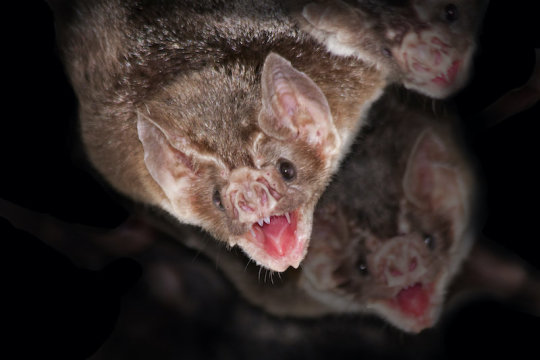

ScienceDaily recently featured a study conducted by researchers at The Ohio State University on the behavior of sick bats in the wild. Their research showed that “when vampire bats feel sick, they socially distance themselves from groupmates in their roost – no public health guidance required.”
Researchers analyzed the behavior of 31 female wild vampire bats after they were injected with either a saline placebo or a substance that activated their immune systems to make them feel sick for several hours. Custom “backpack computers” were glued to the animals’ backs to record and transmit data from their social encounters in the roost for three days after injection. The researchers focused on three measures, including how many bats were encountered, the total time spent with other bats, and how connected each bat was to their social network.
Transmitted data showed that healthy bats stayed away from sick bats and that “sick bats interacted with fewer bats, spent less time near others and were overall less interactive with individuals that were well-connected with others in the roost.”
Simon Ripperger, a co-lead author of the study and postdoctoral researcher in evolution, ecology and organismal biology at The Ohio State University, compared the bats’ behavior to social distancing during the COVID-19 pandemic. Ripperger explained that “in the wild, vampire bats – which are highly social animals – keep their distance when they’re sick or living with sick groupmates. And it can be expected that they reduce the spread of disease as a result.”
The data gathered for social encounters with links between exposure time and pathogen transfer will help researchers predict how sickness-related behaviors influence pathogen transmission within a social network.